
ETL and RAG: The Key to Reliable AI
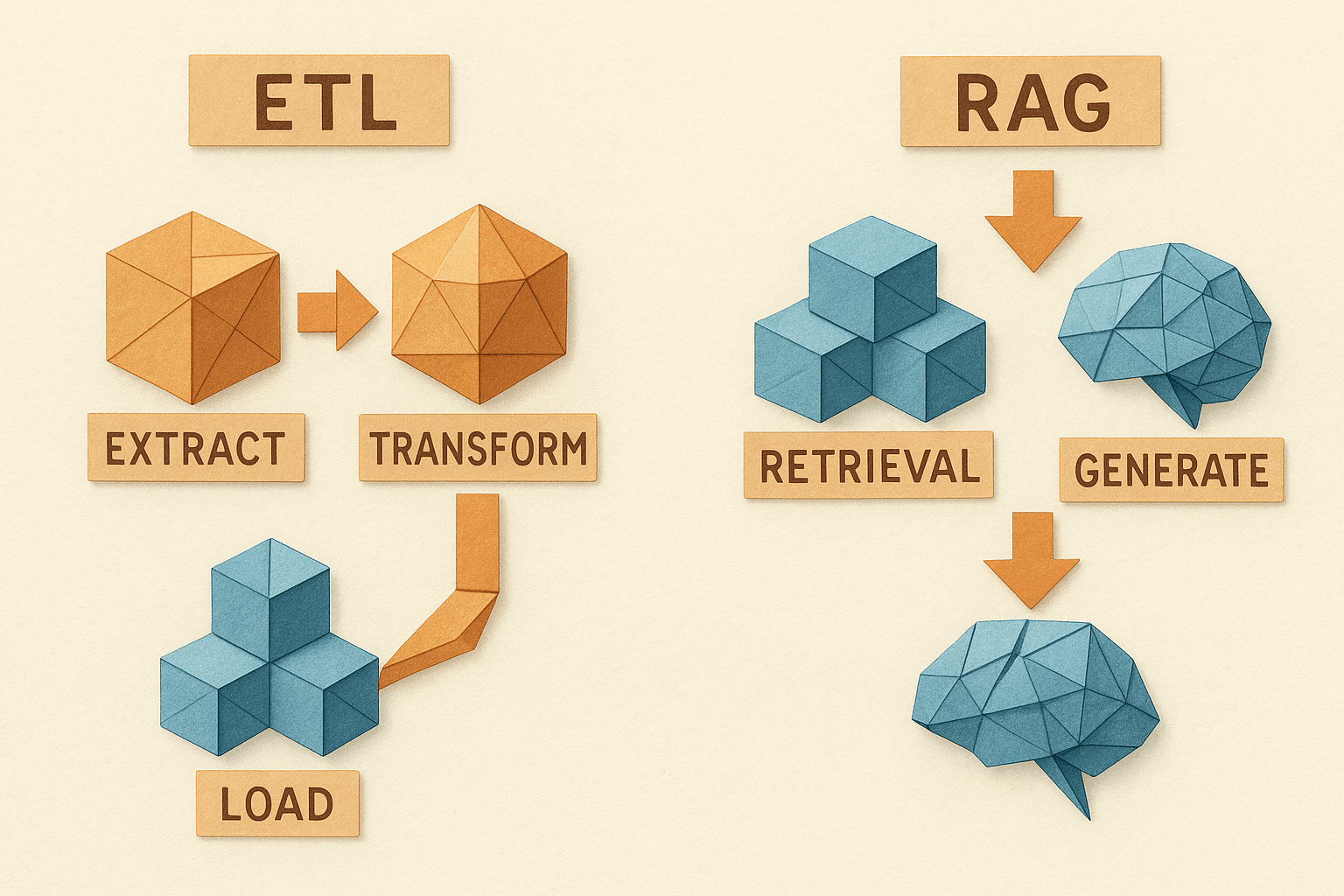
There is a lot of discussion about generative AI and how large language models (LLMs) are transforming the way we work. But making that change useful in real-world settings takes more than a powerful model. It takes RAG.
RAG (Retrieval-Augmented Generation) combines two essential steps:
- Retrieving information from an external knowledge base, such as documents, databases, wikis or reports.
- Generating richer answers with the model, using that information as context.
This means the LLM does not rely solely on what it already knows. It draws on up-to-date, specific knowledge, reducing hallucinations and producing more reliable answers.
Where does ETL come in?
For a RAG system to work, connecting documents to a model is not enough. The data needs to be extracted, transformed and loaded in an organised way. That is where ETL (Extract, Transform, Load) comes in.
- Extract: bring together information from different sources, including documents, databases, websites and audio.
- Transform: clean, normalise and split the information into usable chunks.
- Load: store it in an accessible repository, such as a vector database, that the model can query.
When ETL is poorly implemented, RAG builds its answers on incomplete, duplicated or disorganised data.
When ETL is done well, RAG has a clean, organised and enriched library to draw on.
Why does it matter so much?
In a RAG project, the model is only as good as the data it receives. The prompt depends directly on the quality of the ETL process.
A solid pipeline:
- reduces hallucinations,
- keeps information up to date,
- makes answers traceable and trustworthy.
In RAG, the unsung hero is ETL.
It provides the foundation that makes artificial intelligence useful and reliable as well as impressive.